Friday, November 21, 2008

Roman Mosaics

Mosaics, I remember a friend of mine having them in his house. They were partial located on the windows. With different bright colors, I could see simple images appearing in the window. If I drove on my bike past a church, I too, saw large windows with mosaics. I always thought it was something pretty and unique, giving a different 'dimension' to the buildings and windows. But when I was going through the homework assignments, I couldn't believe what I saw. Multiple artworks, that I could barely tell if it was mosaics or not. Mosiacs were used widely in the Hellenistic times, but in the chapter of the Roman period I was blown away by the artworks. Even though I was talking about colored glass in the windows, back in the Roman Period mosaic was also consisting out of colored stone and marble. They were used in the first place for practical uses, like water resistant floors. But when the artworks started to set into the floors too, that is where it becomes so pretty. Mosaics went from floors to walls, from colored stone to colored glass.
On page 213, figure 6-58, it is beautifully put on file: mosaic at its finest. (at least in my opinion). It is called 'Battle of Centaurs and Wild Beasts'.
I think it is so impressing because I am used to seeing mosaic figures on the windows of a church, but when I see this much detail, and then I read it is mosaic, I am just astonished. It makes me really excited!

Saturday, November 15, 2008

The beauty of Rome


Rome, the capital of Italy and one of the most populous cities in Italy. It has been around for centuries and has attracted and still attracts a lot of people. We have been covering a lot about the art it brought with them. In this blog I want to address the importance of the city and what it did and still does to the world in my view. When Romulus and Remus founded the city, it was a start of a city that would eventually expend to great size, influence and beauty. An empire it would be, and with it came beautiful pieces of architectural buildings. For example, the Colosseum in Rome is a beautiful example of that:


Rome is nowadays still of great beauty. People all over the world come to visit Rome for the many different possibilities it offers. What about the art? What about the artictecture? Yes, it seems people are still interested in them. And that is what makes Rome so special. A lot of remains from the past, telling the story of what happened back then. Remains that show the world how inventive, great and smart people were back in that time. We can see that present day, by looking at the buildings, statues and other artworks located in Rome. Rome is a museum itself!

Saturday, October 25, 2008

Earrings, earrings and some more earrings.

Nowadays we can't picture girls without having any sets of earrings. With all kinds of materials, figures or whatsoever, there is a major diversity in earrings. Back in the days though, the late classical period to be precise, earrings could be found too as jewelry for woman in that time. But not only living woman, they were also designed for goddesses statues. For example, these hollow gold earrings from 330-300 BCE. are examples of great and hard artwork. These earrings are very detailed and seem to have a motion going on while looking at them. Unfortunately I cannot find the exact picture that is located in the book, but because everyone else in this class has the book I can give the picture number and page number for you to look up and see for yourself. It is on page 155 and it is figure 5-56.

When I want to see if I can translate this ancient piece of art with present day art, it is not so difficult to find. Ofcourse because there are a lot of earrings in all kinds of shapes and materials, it is hard to tell whether it is art or not. So what I did in order to find myself something that is similar or looks like the picture in the book, but is present day, I went to my girlfriend and asked for help. The first thing she said was: "wing earrings", and as soon as I heard that I went online and found myself some pieces of earrings that looked like that. These gold earrings look a little bit like the ones in the book. Ofcourse they do not represent the same, but I do feel like there is a bit of closer connection to it. There are many wing earrings like these, and there are also many angel earrings too. It is the thought and motion behind the earrings of the ancient greeks that make the difference in value.

Saturday, October 4, 2008

Old and Present Lions


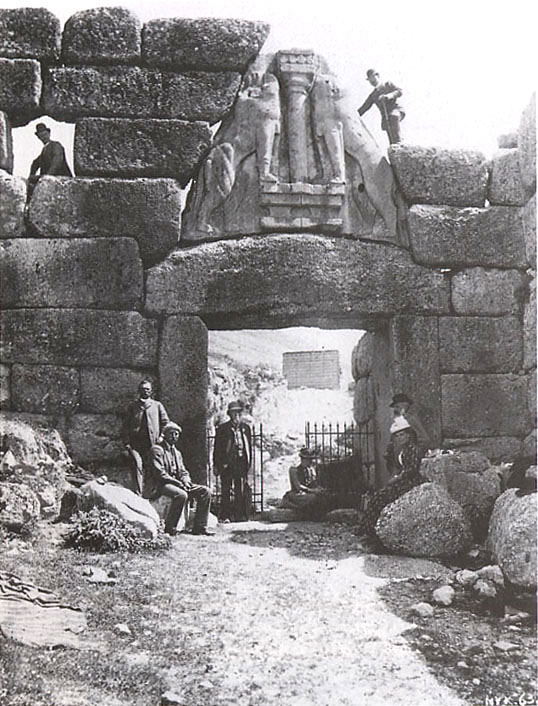
This is the lion gate at Mycenae, a beautiful gate that definitely brings interest to me. Two mean looking lions symbolically guarding the entrance making it for intruders hard not to be intimidated. Being the only entrance that leads to the palace I must say it is a great choice of art to put it as entrance.
When I am looking at gates we have today, there are many to find. From old society art works to present day art works. For example, I come from the Netherlands and I remember when I went to the city of Amersfoort, coming across old entrances that used to serve as entrances to the city itself. Because the city used to be surrounded by a big stone wall, having only these entrances there. When I was looking on the internet trying to find more about this lion gate, I came across a site where they mentioned 'lion gate' located it New York. These lions can be found at the New York Public Library. These lions also look very impressive, and I find it a cool way to connect this old ancient art to present day art. See for yourself and enjoy.

Saturday, September 27, 2008

Preserving the dead


When I think about Egypt I think about beautiful pyramids, golden masks and mummification's. The last one is the one I want to talk about in my undirected blog. In order to make sure the body ends up living in the afterlife, Egyptians used mummification's. By removing the brains through the nose, cutting open the left side of te body to empty the body cavity, and placing the body and vital organs in a vat of natron, the Egyptians completed their mummification.
Nowadays we have all different kind of interpertations about afterlife. Also the way we thread our closed ones after passing away is completely different. We choose to burry them or have them into ashes. In one way or another, we do not seem to have anything close to the way Egyptians treated their dead ones.
Or do we? Well, they are not human beings, but they do seem to come pretty close to mummification. It sometimes get performed when peoples pets pass away, some get them preserved. The organs and everything gets taken out and the skin is stuffed. It may come close, but the spiritual and religious thought behind it is completely different from that of the Egyptians!

Friday, September 19, 2008

Cuneiform Writing


Writing down records, laws and stories, this is what we still do and what our ancient ancestors used to do. The Sumerians were one of the first to find a way to write stuff down. With wedge-shaped symbols, they pressed a pointed writing instrument into clay tablets to keep business records (Chapter 2, page 29,32). First they use to have pictures displayed, but as time went by, their way of writing evolved with them, making instead of pictograms now phonograms. Even though, they didn't had a alphabet yet, making it different from our 21st century daily life.


Looking at 21st century everyday life, we can say that our way of writing down became universal. Even though there are different alphabets because of different languages, large numbers of people do know how to translate and read these symbols. We write stuff down, we type our emails, we have subtitles in movies, all these different ways of putting written letters into use.


Communication is a wonderful and powerful way of human beings to tell each other something. This is why it is so unique to have ancient art pieces of the beginning of writing. It tells a lot about the society back then, and helps us understand of how they used to live and interperate things that happened to them. We are doing exactly the same as they did, and who knows: a couple of thousand years later human beings still communicate this way, and are looking back at our work, seeing how we use to live and think!

Thursday, September 11, 2008

Undirected time change


It is evening, its dark and there is absolute no way to see anywhere further then your own hand. The only sources of light are the moon and the stars, which do not provide enough light for us, human beings, to look around and see where we are. We need a source of light! Back in the prehistoric days our ancestors were living in caves. The cave sculptures and paintings took a lot of work and time from our ancestors. Far and deep into the caves there wasn’t enough light, so they had to find a way to create a source of light. That is where lamps were used, such as The Lamp With Ibex Design, figure 1-12 on page 11 in the Art History book.

This lamp was found at La Mouthe, which is located in France. The lamp is decorated with engraved images.

As I mentioned before, the need of light around us has been a stationary need. Looking at the prehistoric lamp and relating this lamp to our modern daily life, there has been a lot of changes made. A big evolution took place for the lamps. With the rise of electricity and better understanding, these changed were made possible. The figure 1-12 in my art book has decorations all over it. But even today people still decorate their lamps, like they did in the prehistoric time. When I am trying to compare the lamp from prehistoric time to the lamps we have right now, they do not seem anything a like. Our thought of how lamps look like are completely different. This makes the finding of this lamp in the La Mouthe Cave even extra special and precious, making this object a piece of history and a piece of art!